


Does this sound familiar? Your company's website and job descriptions all proudly declare you're "API-first." But when you sit down to actually use the API, the experience can be different. The documentation may be incomplete, endpoints behave in unexpected ways, and a minor update breaks your integration.
This gap between the buzzword and reality is often called the API First Lie. It’s the promise of a smooth process that turns into a challenge for any developer who has to use the API.
This isn't just a small inconvenience; it has real costs. Documentation is the entry point to your API. When over 80% of developers say clear docs are a huge factor in their decision to use an API, neglecting it can hinder adoption, causing the API to be underutilized.
Here, we're going to unpack the most common myths about the API-first approach. We'll get into what it really means and show you how to actually do it right.
An API-first approach means treating your API as a primary product, not an afterthought. It serves as the official contract that defines the rules for how different components, such as your web app or a partner's integration, will communicate. This contract is finalized before any implementation code is written, typically using a standard like the OpenAPI Specification.
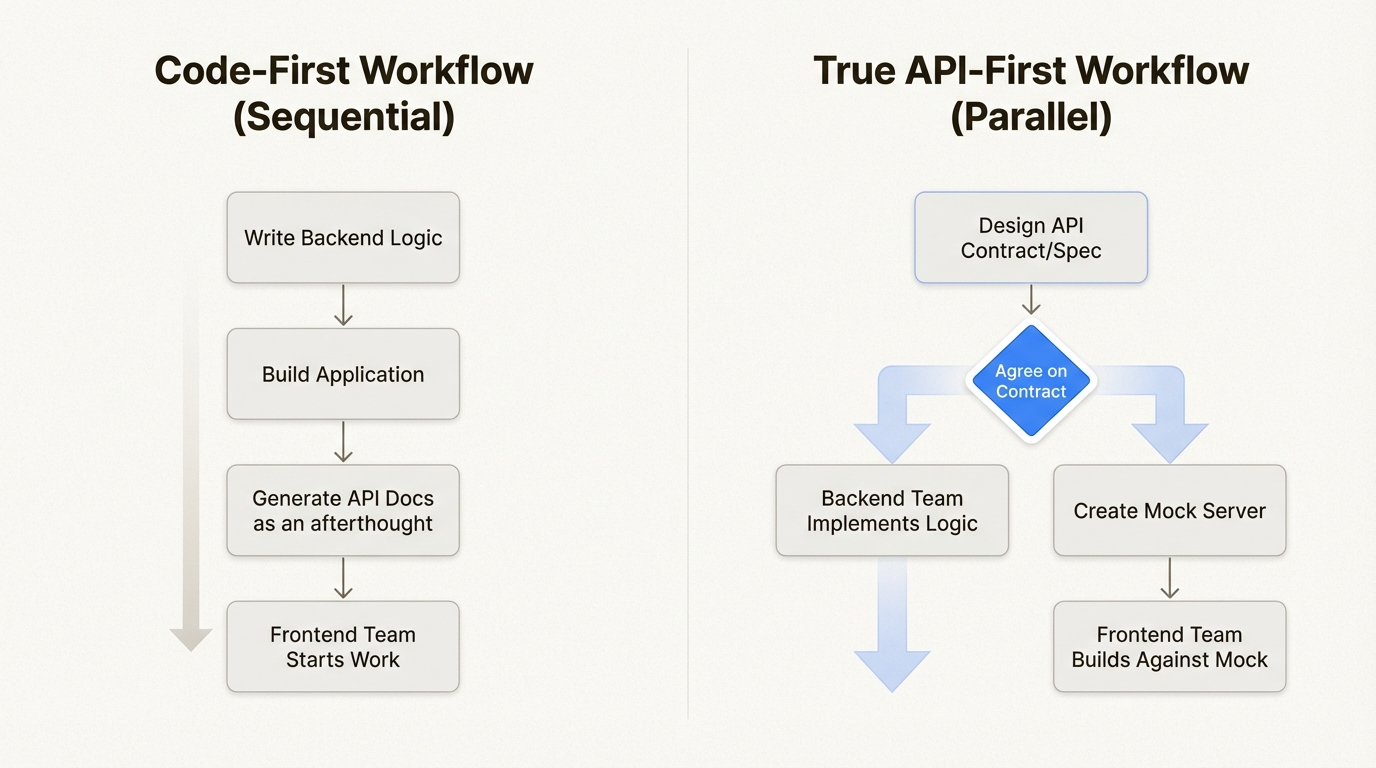
This is the opposite of the older "code-first" method. With code-first, teams would build the application first and then create an API for other services to connect. This often led to inconsistencies. The API design was inconsistent because it reflected the internal code structure. This could result in a challenging developer experience, with teams often waiting on each other. Many developers feel that generating specs from code, a common code-first practice, can be unreliable.
A true API-first strategy follows a few key principles:
1. Design Before Code: The API specification is the source of truth. It’s designed and agreed upon by all stakeholders, from backend engineers to product managers, before development begins.
2. Parallel Development: Once the contract is stable, front-end, back-end, and mobile teams can all work simultaneously. They use the API specification to create mock servers. The front-end team can build the UI against a mock API that behaves like the real one, which accelerates the development process.
3. Prioritize Developer Experience (DX): Since the API is built for other developers, the focus must be on their needs: consistency, clarity, and great documentation. Usability is as important for developers as it is for the end-users of an application.
Here’s a quick look at how the workflows compare:
It's easy to claim an API-first approach, but execution is where challenges arise. Certain shortcuts, while seemingly efficient, can lead to significant technical and documentation debt. This isn't just about disorganized documentation; it's about the risk and cost that accumulate when the API contract is not maintained.
This is a common challenge. You may have heard statements like:
Why it’s a pitfall
An API with inaccurate or outdated documentation can be considered an incomplete product. In an API-first world, the documentation is the contract. It's the user manual and the source of truth that consumers rely on. When you treat it as a task for later, the model's effectiveness is reduced. You're not API-first; you're code-first with good intentions.
The consequence (documentation debt)
"We'll do it later" often doesn't happen. New deadlines appear, priorities shift, and the documentation task gets deprioritized. This is how documentation debt accumulates. Every undocumented change and every missing parameter description adds a layer of confusion.
Over time, the API can become difficult for new developers to onboard. They spend days trying to understand how it works, requiring them to ask senior engineers for help, which can impact productivity. This is the opposite of the speed API-first is supposed to provide. In the age of AI, this is even more critical. As HubSpot's CTO noted, AI coding tools are less effective if the documentation they're supposed to "read" is wrong or doesn't exist.
The solution
The only way to address this is to treat your documentation with the same importance as your code. It has to be part of your development workflow, not something you do "when you have time." Automation can help. Tools that integrate directly into your existing processes can prevent documentation debt from forming.
For instance, a platform like EkLine Docs Reviewer can hook into your CI/CD pipeline and GitHub pull requests. It can automatically check for documentation changes alongside code, enforce your team's style guide, and flag issues like broken links or missing descriptions. It makes maintaining the contract an automated part of shipping code, so your documentation remains current.
This pitfall is more subtle. It’s about small design choices made for short-term developer convenience that create a challenging experience for the API consumer. It often sounds like this:
Why it’s a pitfall
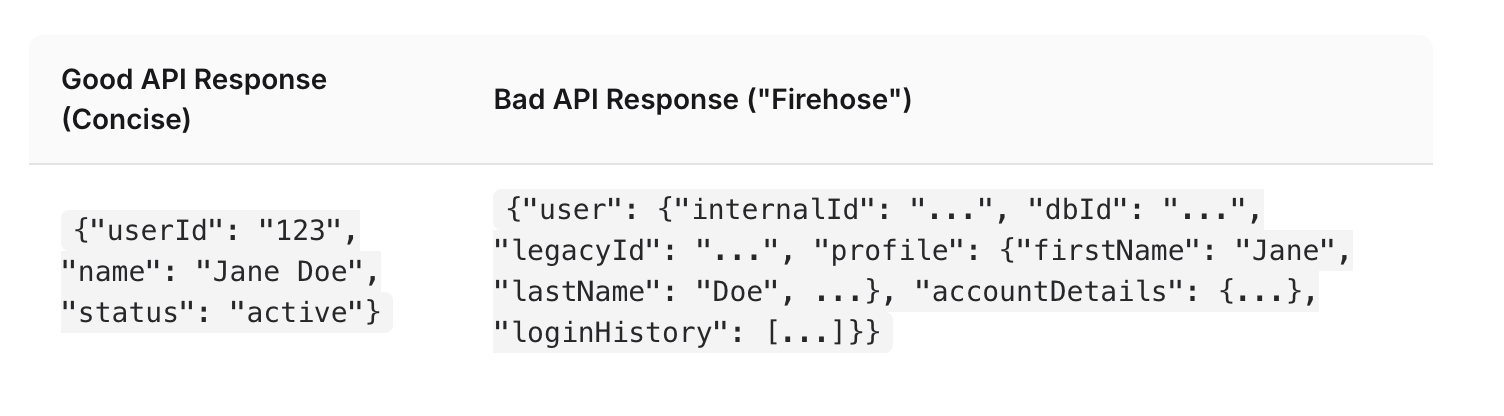
A key part of the API-first philosophy is caring about the Developer Experience (DX). When you provide a large, undocumented data object, you are not saving time. Instead, you are shifting the work of parsing and understanding the data to the consumer. This forces them to reverse-engineer your system instead of building features. And skipping security, even for an "internal" API, introduces significant risks. The idea of a completely secure internal network is often an outdated assumption in today's world of microservices and cloud infrastructure.
The consequence (poor DX and high risk)
These shortcuts can lead to APIs that are complex and difficult to use. This can hinder adoption and increase the number of support requests from developers. The API may gain a reputation for being difficult, and people might avoid it. The security risk is even more significant and can lead to data breaches.
The solution
A great developer experience starts with documentation that is clear, consistent, and full of context. It's not enough to just list endpoints; you have to explain the "why" behind the design. You can empower your engineers to be great documentarians without slowing them down.
When an engineer adds a new feature, they have all the context. Instead of letting that knowledge disappear, a tool like EkLine Docs Agent allows them to use simple prompts to quickly draft accurate documentation for new endpoints, update descriptions, and generate examples. It helps capture that vital context at the source, ensuring the documentation is as well-crafted as the code.
This is the challenge of over-relying on tools. It's tempting, especially with so many developer tools available. This approach often sounds like:
Why it’s a pitfall
First, specifications auto-generated from code are just a starting point. They are useful for creating a basic skeleton of your API, but they often lack the human-added context that makes an API usable. This can lead to an "inside-out" API design that exposes your internal database structure instead of offering a clean interface designed for your users.
Second, technologies like GraphQL don't eliminate design work; they just shift its focus. You still have to design a logical schema. You still have to think about query complexity, performance, and how to evolve your schema over time without breaking clients. The design work is still there, it just looks different.
The consequence (unusable "contracts")
Teams that take this approach may end up with API contracts that are technically correct but not user-friendly. The documentation may exist, but it's a raw, machine-generated text that doesn't provide enough explanation. The documentation may lack essential explanations. This leads back to the same problems: frustrated developers, difficult integrations, and wasted time.
The solution
The right approach is to use tools to assist humans, not replace them. Let auto-generation create the raw materials, but then use smarter platforms to refine them. An AI-powered platform like EkLine, Inc. is built for this purpose. You can use the Docs Agent to take a raw spec and easily add rich descriptions, clear examples, and helpful context.
Then, you can use the Docs Reviewer, which has a powerful API Spec Reviewer feature (available on the Standard plan), to enforce quality and consistency across your entire API. It helps ensure the final documentation is not just technically correct, but also clear, helpful, and human-friendly.
Beyond these common pitfalls, understanding the human element of documentation is crucial. Poorly designed or documented APIs can feel like a betrayal of trust to the developers who rely on them. For a deeper dive into the consequences of bad API documentation and how it impacts developer experience, this talk offers some valuable insights.
This talk by Michaela Halliwell offers valuable insights into the consequences of bad API documentation and its impact on the developer experience.
Ultimately, a true API-first approach is a cultural shift, not just a new tool. It's a commitment to treating your API as a real product, with users who deserve a great experience. It’s about seeing the API contract as the foundation of your development process.
Achieving this requires addressing common misconceptions. Documentation isn't an optional task for later; it's the core of the contract. Implementation shortcuts that compromise the developer experience can create long-term challenges. And technology should enable good design, not be a substitute for it.
The key to adopting this approach is to start treating your API documentation with the same respect as your code. It needs to be designed, maintained, reviewed, and tested. This doesn't have to be a painful, manual process. You just need to build documentation quality directly into the workflows your developers already use.
Stop falling for the API First Lie. A genuine, powerful API-first strategy is well within your reach when you have the right tools to treat your documentation as the product it is. See how EkLine, Inc. helps teams build and maintain high-quality, reliable API contracts that become their greatest development asset.
The most common sign is outdated or missing documentation. If developers are constantly asking basic questions about how endpoints work or what parameters to use, it’s a clear indicator that the API contract isn't being treated as the source of truth.
Look for project delays caused by team dependencies. If the front-end team is always waiting for the back-end team to finish, it suggests they aren't working in parallel from a [shared API contract](https://www.reddit.com/r/softwaredevelopment/comments/1nqivf5/api_contractfirst_development_best_practices/), which is a core symptom of the API First Lie.
Not by itself. Tools can help, but the API First Lie is a cultural problem. Relying solely on a tool to auto-generate specs without a commitment to design, documentation, and developer experience will just lead to a well-formatted but still unhelpful API.
Absolutely not. It's just as damaging for internal APIs. Poor internal APIs create friction between teams, slow down development, and increase onboarding time for new engineers, hurting the entire organization's productivity.
Start by treating your documentation as a product, not a chore. Integrate documentation review into your code review process. Making accurate, helpful docs a required part of shipping code is the most effective first step to making your API contract reliable.